

Harmonious Conservation in the Course of Change
Wand Smoke: The Seven Scholars

During the virgin voyage of terror galley Tòngkŭ, the soon-to-be feared slave ship served as home not to seven scholars, but to Fènghuáng and Ryōshin alone. With only the captain and his pet macaque to maintain order among the oarsman and sobriety among the shiphands—even before the conclusion of their first course along the Neverlands’ northern coast, it became clear that they would not last a second season without a first mate aboard who could enforce stringent discipline.
And so, while anchoring for supplies at Kaizoku Cove, Fènghuáng and Ryōshin paddled their chattel to Hashima Island’s pirate port. From there, they ventured inland beyond the wharves in hopes of finding their perfect first mate among the auctioned slaves. What they found instead was a piquing altercation.
Two pledgeless seamen, both quite young and hot tempered, were bickering with the auction assessor about the origin of their goods.
One of the young men, visibly drunk and yet far from done drinking, slurred angrily as he sipped rum from a gourd. “What’s it—sip—matter exactly where they’re from? North or south, they’re—sip—Hēi Kòu, ain’t they?”
The other young man backed his companion. “Indeed. Surely recording their precise origin is but a tradition, a formality and therefore unnecessary. Would it not be better just call a Hēi a Hēi and later sell him as whichever is of greater demand?”
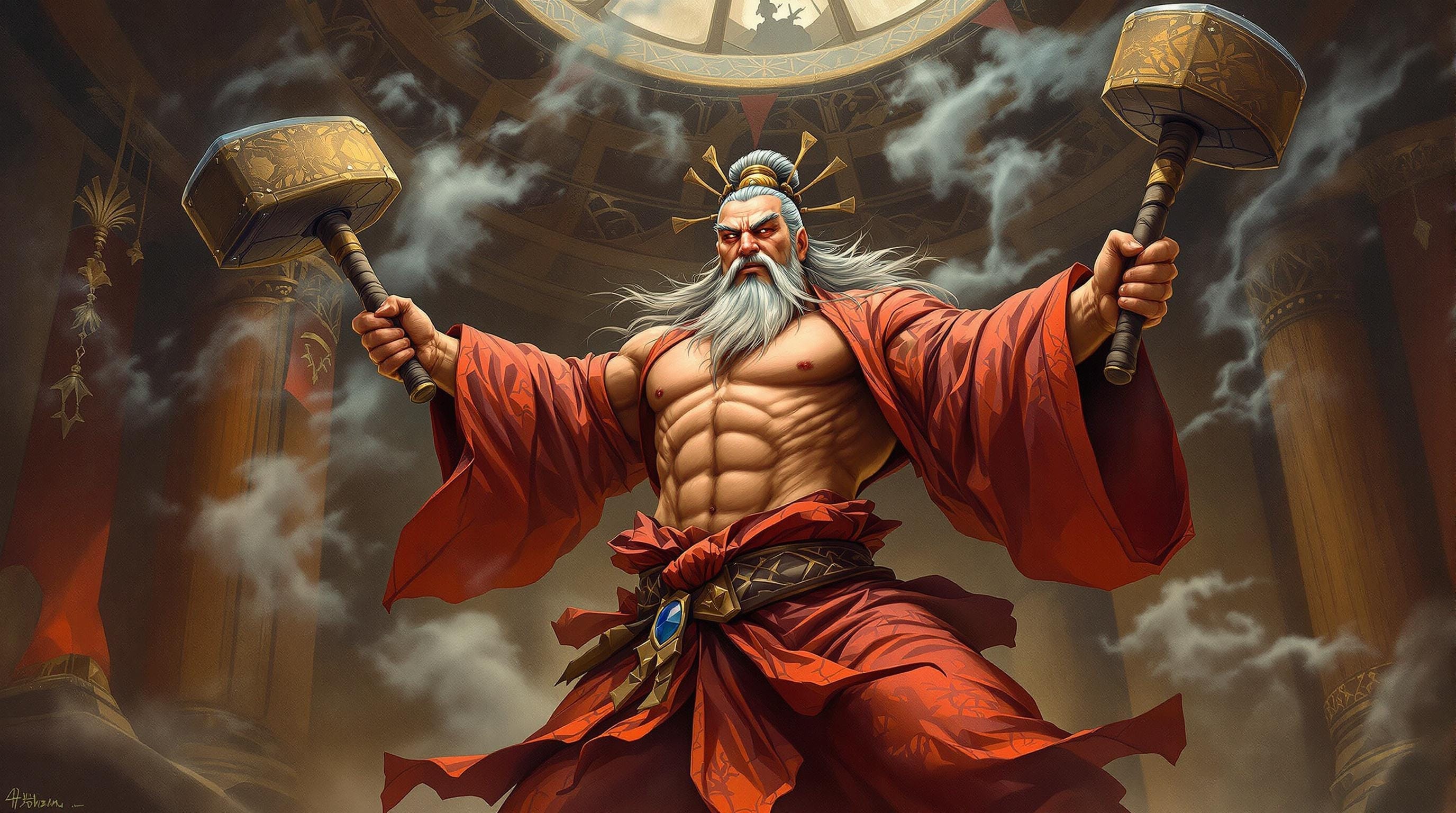
The assessor shook at the suggestion, undulations roiling his waist-length beard as if it were a river. His eyebrows tremored as well from blood drumming the veins in his temples and forehead. Yet amazingly, his tall, black scholar’s cap did not topple from his head, not even as he rose; both his red overcoat and silk-smooth mane lay tranquil despite the violence of his movements.
“Ignoramuses!” he bellowed. “You speak as though words can be exchanged like rooftiles, as if they are not the very foundation-stones of a castle or the keel of a ship!” He pointed toward the drunkard. “Say there is no difference, do you? What will you say to the man who buys a desert dweller for the frigid Yamizuma mines?” His arm swung like an iron rod toward the other seaman. “What will protect the Cove’s reputation then, when our traditions have been abandoned?”
The sober of the two pledgeless pirates, chaffed by the assessor’s rebuttal, replied indignantly as a child caught breaking a priceless vase and boldly claiming its beauty will be much improved once it has been lacquered together again. “What will protect the reputation of the Cove? Only the same speed, power, and technique that beat the northern mountain boxers and the wrestlers of Dakshin!” He took an unorthodox fighting stance light as a butterfly on the wing. “But forget those has-beens. Right now, I’d worry more about how tradition’s going to protect you, old man!”
“Is that so?” asked the assessor, “Attend closely, then. For it is said among my father’s lineage that if a teacher speaks from start to finish, shining a candle in each corner of the wheelhouse of his ship, and a pupil still cannot understand, then—whether it be the fault of the student or the lesson—he ought not waste his breath giving that lecture again.”
“You hear that, Jūn-Făn!” mocked the drunk. “This old timer says he’s going to teach us a lesson!”
His sober fellow laughed. “Then you better watch out, Sìhng Lùhng; you never were very sharp!” He glared at the assessor, no longer smiling. “You too. You must be pretty dull to think a soft bellied bureaucrat can bully a couple of real battle hardened pirates.”
“Blunt,” the assessor corrected him. “The proper word to describe my ancestral way of thinking is, ‘blunt.’”
Then both the seamen’s faces paled aghast as the bureaucrat let his overcoat slip from his shoulders to hang about his waist. From his sash upward, the man’s muscles bulged big and solid as boulders. And from below his desk, he drew two huge clubs weighted by studs cast from lead. Carved into one club was the word Sincerity, and into the other, Discipline.
“Hey! No fair!” rebuked the sober Jūn-Făn. “Nobody is allowed to carry weapons back here but—”
“Minister Kŏng!” blurted drunken Sìhng Lùhng. “The right hand of the pirate king!” Then, without warning, the inebriated seaman swung with his gourd for the assessor’s head. The rum vessel met mid-stroke with the club dubbed Sincerity, and the gourd shattered along with the seaman’s hand.
“These two heirlooms have been in my family for generations,” uttered Kŏng, minister of and younger brother to Pirate King Péi of the century-long, contiguous, Hé dynasty.
Stepping around his desk, the assessor resumed his explanation. “And for generations, the sons of Hé have cultivated our strength by sustaining the training forms innovated by our forefathers. Yet you!” Kŏng scolded the sober seaman who seemed to shrink in the minister’s shadow. “You presume that because you won a few competitions that you have reinvented the proper order of things, as if each piece of life is not supported by the foundation lain before it!”
“That’s a lot of talk to justify an unfair fight!” retorted Jūn-Făn. “Why don’t you drop those clubs and show me how tough your tradition really is by beating me hand to hand, man to—”
The young man never finished. He could not withstand Discipline crashing down on his head.
Afterward, once the two troublemakers had been caged to be auctioned off with the Hēi Kòu and kŭlì, Captain Fènghuáng and Ryōshin approached the assessor directly, irrespective of their difference in rank. The captain asked Kŏng if he would join Tòngkŭ’s crew. Of course, the minister refused. It would be neither proper nor honorable for a man of his status to stoop to slaving and plundering. So Fènghuáng put in a bid for Sìhng Lùhng and Jūn-Făn instead. He wagered all eight of his captive kŭlì, knowing no sane man would pay more than four for those two useless, unruly shiphands.
Kŏng, confused by the captain’s bid, could not help but to ask for what purpose Fènghuáng wanted them. “Surely,” the assessor suggested, “you intend to feed them to that yokai macaque on your back. For no doubt, he can be no mundane monkey nor you anything but a sorcerer to have use of these ruffians.”
The captain shook his head and said, “I intend to buy their freedom then hire them for my crew.”
This enraged Kŏng, as Fènghuáng knew it would, for the sincere, disciplined, and inflexible minister could not stand to see delinquents go unpunished. He tried to protest the captain’s actions but knew of no precedent by which to deny him. Fènghuáng was entirely within his rights to do with his chattel as he pleased. And so, Kŏng made the only appeal at his disposal. He spoke to the pirate’s sense of shame.
“I suppose you’re right,” admitted Fènghuáng as Ryōshin lifted the captain’s hat to get at the lice under it. “It would bring shame to Tòngkŭ’s name to take them aboard as they are. But there is no other way. It is beneath a captain’s station to discipline his own men, and I have no first mate to whip them into shape. If only…”
He left the rest unsaid. There was but one conclusion which properly followed.
Ryōshin grinned, and Kŏng’s eyes narrowed.
“You really are a sorcerer, and the monkey an oni.”